
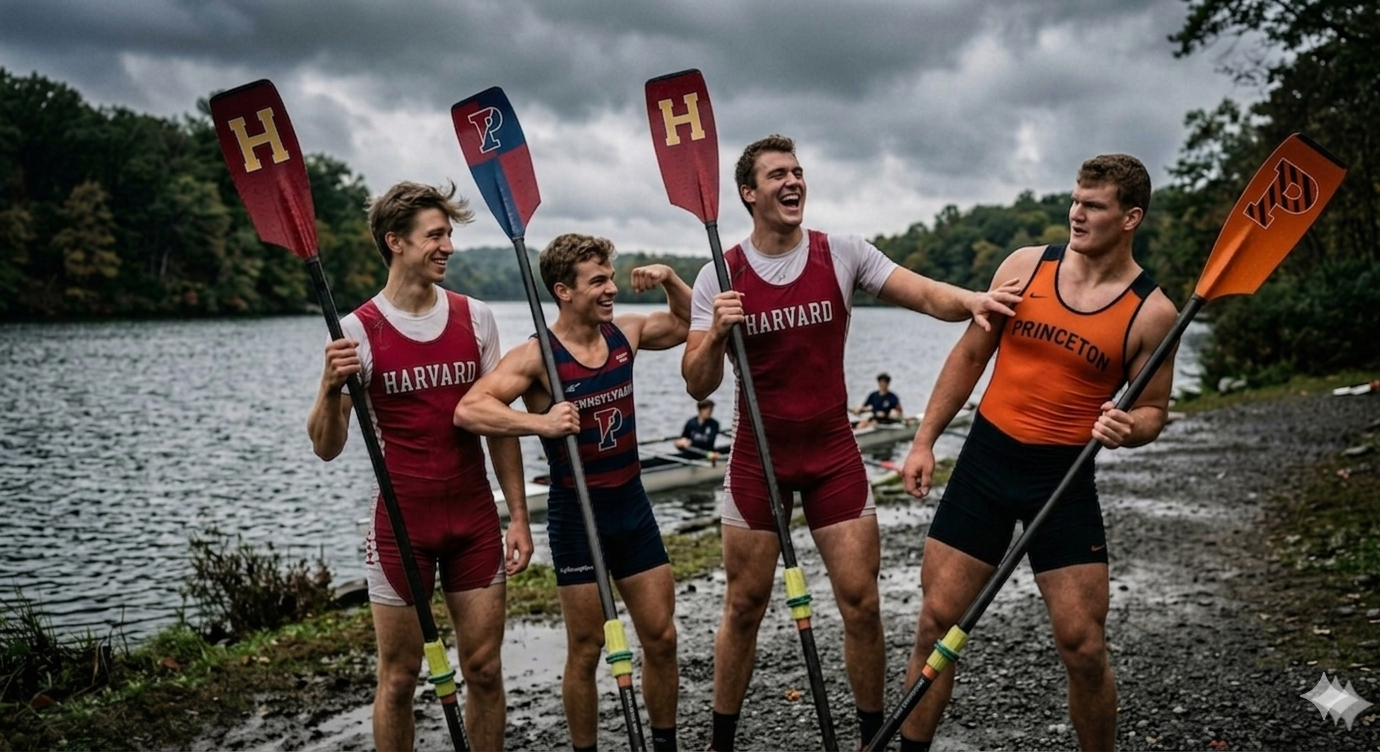
Eleven events, fifteen points covering the top six, six different pick sheets behind those scores. The cleanest message from the Eastern Sprints 2026 leaderboard is that the regatta belonged to the contrarians. The consensus top pick won three of eleven races. Five different programs picked up the other eight golds. And the players who climbed the board did it by catching those outsiders, not by collecting more correct picks than anyone else.
The leaderboard
| Rank | Player | Points | Correct | Outsider golds | Marquee call (V1H8) |
|---|---|---|---|---|---|
| 1 | JFoDC | 220 | 6 | Navy A, Columbia, Brown | Princeton ✗ |
| 2 | Tyrannosaurus Rex | 215 | 6 | Columbia | Harvard ✓ |
| 3 | tim34 | 210 | 7 | Brown | Harvard ✓ |
| 4 | BFWBeluga | 206 | 6 | Brown | Princeton ✗ |
| =5 | Joseph Koyfman | 205 | 5 | Navy A | Princeton ✗ |
| =5 | AdiTim | 205 | 5 | Columbia | Princeton ✗ |
The headline: tim34 had the most correct picks of anyone in the top six (seven) and is third. JFoDC has six and is first by five clear points. Stacking outsider golds outscored stacking chalk. And the V1H Harvard upset - caught by only two of the six — was in a category of its own on points.
The players
JFoDC (1st, 220 pts). The cleanest demonstration on the card that the leaderboard rewards courage in the contested races. Hit three different outsider golds: Brown in the V4H (23.17% pick share - the contested call the preview flagged), Navy A in the 4VL8 (16.87% - the contrarian's-playground call), and Columbia in the VL4 (9.76% - the genuine left-field call). Paid for misses on the 2V8, 3V8, 2VL8 (all Harvard, all wrong), the V1H8 (Princeton, lost), and a lone-wolf Dartmouth call in the 5V8 that didn't land. Even with five wrong, the three outsider hits gap them clear.
Tyrannosaurus Rex (2nd, 215 pts). The only scoresheet on the card with the V1H Harvard call AND the Columbia VL4 call. Two of the day's three most expensive contrarian reads stacked on one line. The V1H8 alone is the single biggest read anywhere - Princeton at 53.57% in the picks, three seconds clear in the heats, and Tyrannosaurus Rex took Harvard anyway. That call is most of what kept them within five of the lead despite missing both 4VL8 and 2VL8.
tim34 (3rd, 210 pts). The board's volume picker. Seven correct picks, the most of anyone in the top six - including the V1H8 Harvard upset (with Tyrannosaurus Rex), the Brown V4H call, and a clean read on the Princeton sweep through the 3V8, 4V8, and 5V8. The misses cost: Harvard in the 2V8 and 2VL8, Princeton in the 4VL8, and Harvard in the VL4. Being third on seven correct picks instead of first on six is the clearest signal in the data about how the scoring treats contrarian gold.
BFWBeluga (4th, 206 pts). A near-twin of JFoDC's scoresheet, but with two material divergences: Princeton in the 4VL8 (Navy A won) and Princeton in the VL4 (Columbia won), where JFoDC went outsider on both. Two contrarian calls swapped for two consensus calls, both consensus calls wrong, and the gap between first and fourth opens up. Same six-correct count, fourteen-point spread.
Joseph Koyfman and AdiTim (=5th, 205 pts). Mirror images. Same five correct picks, same total, different contrarian win: Joseph Koyfman caught Navy A in the 4VL8 and missed Columbia in the VL4; AdiTim caught Columbia and missed Navy A. They have effectively swapped one upset for another and ended up at the identical score. The scoring system saying, loudly, that the two outsider golds are interchangeable in value.
What separates the top from the chasing pack
Three of the eleven races account for almost all the differentiation across the top six:
- The V1H8 (Harvard upset over Princeton) - caught by Tyrannosaurus Rex and tim34 only. The biggest single-race separation on the card.
- The 4VL8 (Navy A) - caught by JFoDC and Joseph Koyfman.
- The VL4 (Columbia) - caught by JFoDC, Tyrannosaurus Rex, and AdiTim.
JFoDC sits at #1 because they're the only player who hit two of those three AND picked up the Brown V4H call on top. None of the top six had a complete scoresheet. The combination of JFoDC's three outsider golds plus Tyrannosaurus Rex's V1H8 call would have been clear of the field - and that combination doesn't exist on any top-six line. It probably exists somewhere lower in the standings, on a player who gained materially on everyone above them this weekend.
Where the leaders left points on the floor
Two specific races jump out from looking down all six scoresheets together:
The Harvard 2V8 / 2VL8 wall. Every single top-6 player picked Harvard in both. Princeton won the 2V8; Penn won the 2VL8. That's twelve picks of Harvard in the 2V slots across six leaderboard leaders, zero correct, twelve points-on-the-floor at the top of the board. Anyone outside the top six who fade Harvard in either race moved up against everyone above them.
The Penn 2VL8 specifically. The Sunday heats update flagged this explicitly - "Pennsylvania in the 2VL8 is the upset to back," with 4.6 seconds of heat-time daylight on Harvard. Nobody in the top six made that read. The single most-actionable read from the heats, and the top of the board uniformly missed it.
The two universal correct holds - Harvard in the V1L (80.72% conviction call, delivered) and Princeton in the 4V8 (all six picked it, all six right). Two unanimous picks at the top of the board, both correct. The other nine races are where the leaderboard was decided.
What actually happened in the racing
| Event | Pick % leader | Winner | Picked by top 6? |
|---|---|---|---|
| Varsity Heavyweight 8+ | Princeton 53.57% | Harvard | 2 of 6 |
| Varsity Lightweight 8+ | Harvard 80.72% | Harvard | 6 of 6 |
| 2nd Varsity Heavyweight 8+ | Harvard 47.56% | Princeton | 0 of 6 |
| 2nd Varsity Lightweight 8+ | Harvard 60.98% | Pennsylvania | 0 of 6 |
| 3rd Varsity Heavyweight 8+ | Harvard 44.44% | Princeton | 2 of 6 |
| 3rd Varsity Lightweight 8+ | Harvard 51.81% | Princeton | 6 of 6 |
| 4th Varsity 8+ | Princeton 33.33% | Princeton | 6 of 6 |
| 4th Varsity Lightweight 8+ | Princeton 65.06% | Navy A | 2 of 6 |
| 5th Varsity 8+ | Princeton 50.62% | Princeton | 5 of 6 |
| Varsity Heavyweight 4+ | Harvard 36.59% | Brown | 3 of 6 |
| Varsity Lightweight 4+ | Harvard 60.98% | Columbia | 3 of 6 |
The preview opened with "Harvard's Lightweight Empire, Princeton's Heavyweight Crown." Reality inverted it. Harvard took both crowns - the V1L chalk at 80.72%, then stealing the V1H8 off Princeton's 53.57% pick share in the headline race the whole weekend was built around. Princeton took the depth chart — every heavyweight event below the V1 (2V8, 3V8, 4V8, 5V8). And Harvard's "lightweight empire" turned out to be one boat deep: the V1L held, then Penn, Princeton, Navy A, and Columbia took the other four lightweight events between them.
The Sunday heats update was, in retrospect, the better tipster than the picks board. It called Princeton's heavyweight depth (right on three of four). It called Penn 2VL8 explicitly (right). It called Harvard V1L (right). The one thing it got wrong was the V1H8 - and that was every preview's wrong, the picks board's wrong, and the rowing world's wrong.
The structural lesson
When the consensus is right in three of eleven, the leaderboard stretches. Fifteen points across the top six and six different pick sheets behind those scores is a board worth reading. The Big Ten 2026 result - thirty players tied at the top on identical Washington-everywhere picks - was the opposite shape. This regatta did the work of separating players because the upsets did the work of differentiating their scoresheets.
The crown went to the player who paired conservative-favourite calls in the chalk races with three genuine outsider reads (Navy A, Columbia, Brown) on crews the room had at single-digit and low-teens pick shares. Not the player with the most correct picks. Not the player with the boldest single read. The player who combined volume with three specific bold reads on outsiders the consensus had written off.